
Department of physics
The Department of Physics was established in the year 1995. It has a tradition of around thirty years of teaching at the under graduate level. Currently the department offers a three year and four year under graduate programme with Physics as major; Mathematics and Computer Science/ Chemistry as complementary (minor) subjects. Students with consistently good academic record in the science subjects at the plus two level are selected to the course. The Department provides effective teaching through lecture method, ICT, discussions, audio visual aids, peer teaching assignments, quizzes and seminar presentations for a smooth learning process. It also conducts the minor courses for B.Sc. Computer Science, B.Sc. Microbiology and B.Sc. Life Science programs. Our students bagged first rank in the year 2001, second rank in the year 2002 and third rank in the year 2008 for B. Sc. Physics program and consistently shows their academic excellence.
The department of Physics has produced very good academic results under the efficient teaching and able guidance of the experienced and well qualified faculty members. The faculties regularly involve in research activities, publishes their works; and are very keen in engaging various extension activities/refresher courses as part of the faculty development. This is one among the rare departments in the state where all of the faculties are Ph.D. holders. The department also receives funds from UGC and KSCSTE under various schemes. Hundreds of our alumni are serving in and outside the country as scientists, industrialists, asst. professors, IT professionals, higher secondary and secondary school teachers, etc.. Many students of the department has cleared competitive examinations like IIT-JAM, GATE, CUCET, etc. during the past years.

OUR VISION
To excel in quality based science education by igniting the young talented minds with novel ideas and to develop a scientific temper and a sense of social commitment in students.

OUR MISSION
To impart quality education both in theoretical and experimental physics through effective Teaching Learning process and to motivate students to pursue higher studies in Physics which will improve their career forecasts.
Faculty - Department of Physics




Competitive Exam
Many students of the department have cleared various competitive examinations. Vaishakh – IIT JAM 2025, Divya M – IIT JAM 2019 and CUCET 2019 ; Arjun Babu – CUCET 2016 ; Amrutha V – IIT JAM 2016 ; Anusree N Prakash – IIT JAM 2016 ; Raji Raghavan – IIT JAM 2015 ; Bindu Kannan – IIT JAM 2013
Competitive Exam
Many students of the department have cleared various competitive examinations. Vaishakh – IIT JAM 2025, Divya M – IIT JAM 2019 and CUCET 2019 ; Arjun Babu – CUCET 2016 ; Amrutha V – IIT JAM 2016 ; Anusree N Prakash – IIT JAM 2016 ; Raji Raghavan – IIT JAM 2015 ; Bindu Kannan – IIT JAM 2013
Quantum Quest 2026
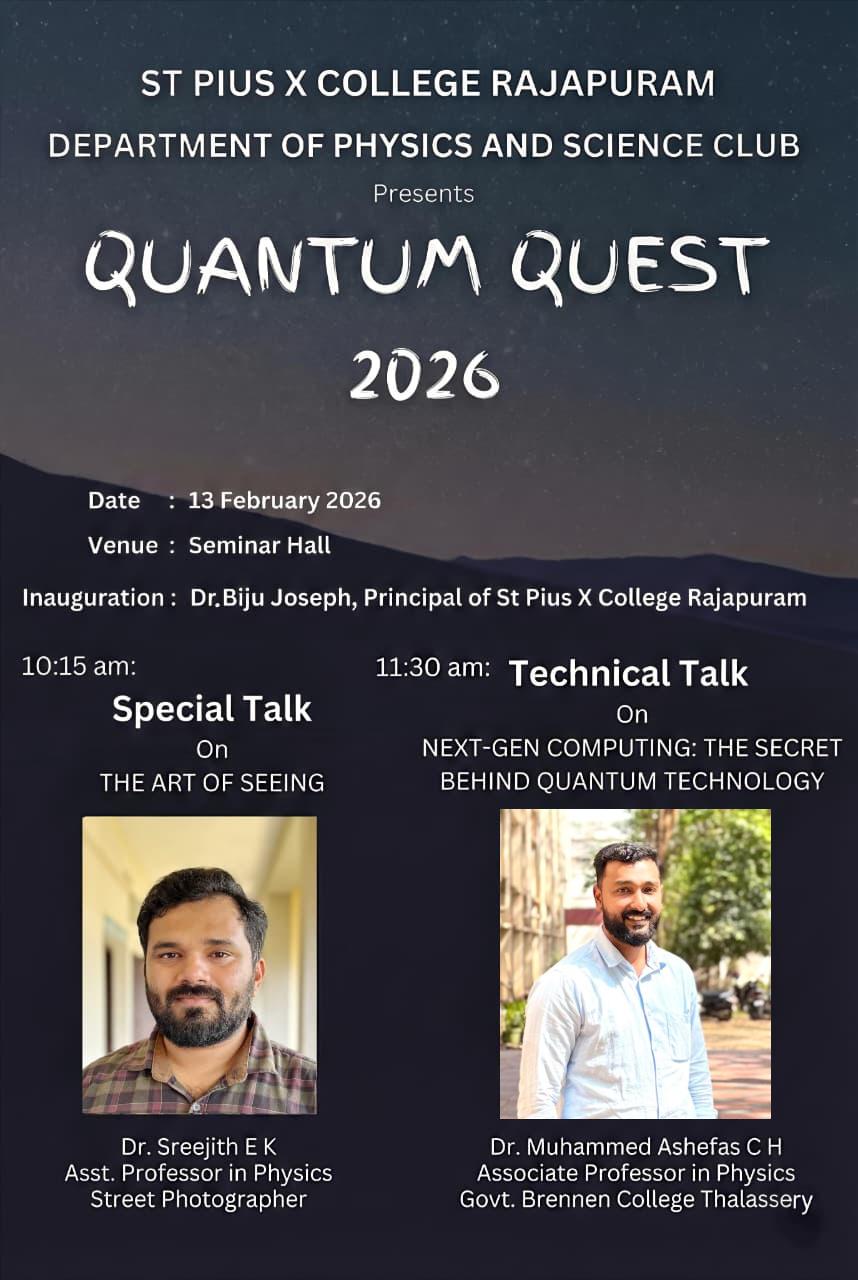
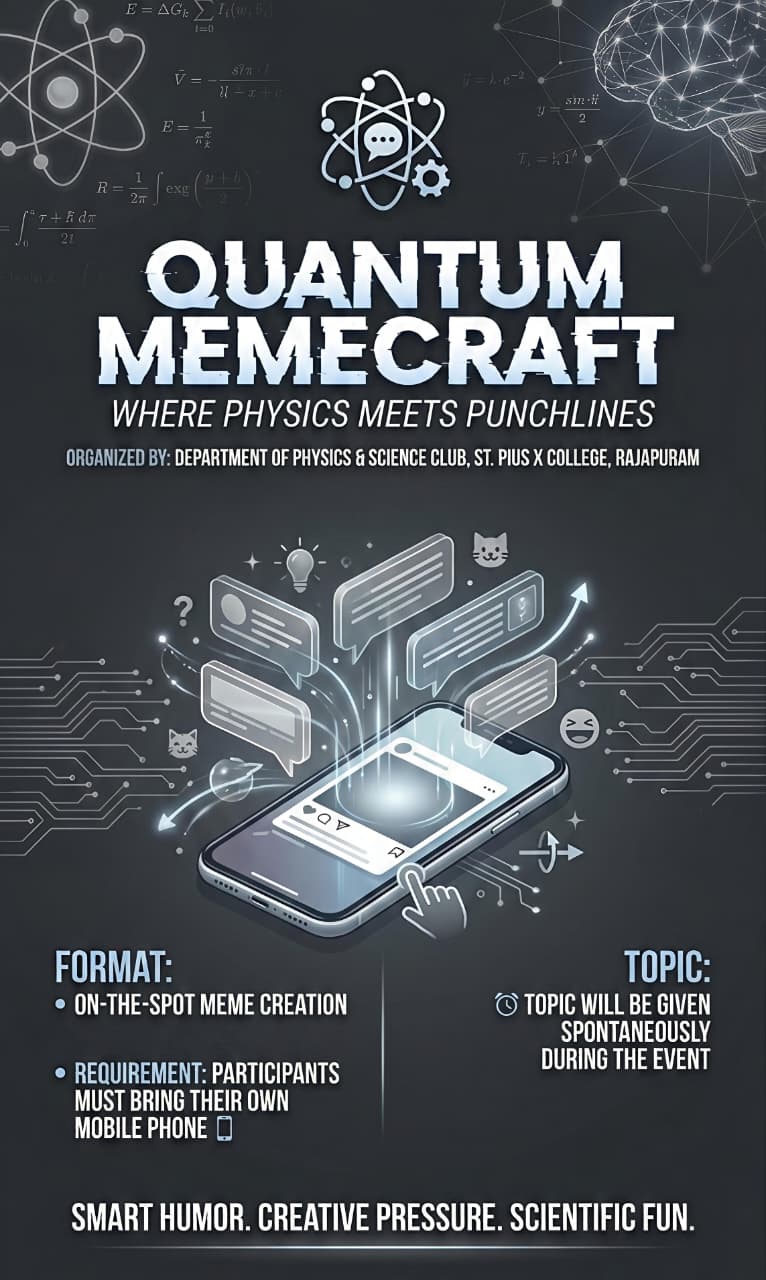
Quantum Quest 2026
The Department of Physics and Science Club of St. Pius X College, Rajapuram organising “Quantum Quest 2026”, a one day academic event aimed at fostering scientific curiosity and promoting awareness of emerging trends in physics and quantum technology. The event is scheduled on 13 February 2026 at the Seminar Hall of St. Pius X College, Rajapuram.
The programme commence with the inauguration by Dr. Biju Joseph, Principal of St. Pius X College, Rajapuram. The academic sessions featured two insightful talks by distinguished speakers. In addition to the academic sessions, Quantum Quest 2026 also featured a variety of science-related games and interactive activities.
Program Outcome
PO 1.Critical Thinking:
1.1. Acquire the ability to apply the basic tenets of logic and science to thoughts, actions and interventions.
1.2. Develop the ability to chart out a progressive direction for actions and interventions bylearning to recognize the presence of hegemonic ideology within certain dominant notions.
1.3. Develop self-critical abilities and the ability to view positions, problems and socialissues from plural perspectives.
PO 2.Effective Citizenship:
2.1. Learn to participate in nation building by adhering to the principles of sovereignty of thenation, socialism, secularism, democracy and the values that guide a republic.
2.2. Develop and practice gender sensitive attitudes, environmental awareness, empathetic social awareness about various kinds of marginalisation and the ability to understand and resist various kinds of discriminations.
2.3. Internalise certain highlights of the nation’s and region’s history. Especially of the freedommovement, the renaissance within native societies and the project of modernisation of the postcolonialsociety.
PO 3.Effective Communication:
3.1. Acquire the ability to speak, write, read and listen clearly in person and through electronicmedia in both English and in one Modern Indian Language
3.2. Learn to articulate, analyse, synthesise, and evaluate ideas and situations in a well- informed manner.
3.3. Generate hypotheses and articulate assent or dissent by employing both reason and creativethinking.
PO 4.Interdisciplinarity:
4.1. Perceive knowledge as an organic, comprehensive, interrelated and integrated faculty of the human mind.
4.2. Understand the issues of environmental contexts and sustainable development as a basicinterdisciplinary concern of all disciplines.
4.3. Develop aesthetic, social, humanistic and artistic sensibilities for problem solving andevolving a comprehensive perspective.
Program Specific Outcome
PSO 1: Understand and apply the principles of Classical mechanics, Quantum mechanics,Thermodynamics, Nuclear physics and Electrodynamics.
PSO 2: Understand and apply the principles of Solid state physics, Optics, Photonics andSpectroscopy.
PSO 3: Understand the principles of Electronics, Design and test electronic circuits.
PSO 4: Understand and apply the principles of Mathematical Physics andComputational Physics and do Error analysis in measurements.
Course Outcome
CORE COURSE I: MECHANICS I
CO 1: UnderstandNewton’s laws of motion, the concepts of linear and angularmomentum and torque
CO 2: Determine the Centre mass of a given configuration
CO 3: Understand the principle of work,energy and power
CO 4: Determine angular momentum of a body about any given axis
CORE COURSE II:MATHEMATICAL PHYSICS AND ERROR ANALYSIS
CO 1: Understand vector operations and vector algebra
CO 2: Determine derivative and integral of various functions
CO 3: State fundamental theorems of calculus
CO 4: Compare differential operators in various coordinate systems
CO 5: Understand the basic concepts of modelling
CO 6: Solve first order and second order ODEs
CO 7: Estimate uncertainties in measured values
CORE COURSEIII: MECHANICS II
CO 1: Understand the concept of Galilean transformations and uniformly accelerating systems
CO 2: Determine the trajectory of a body in central force problem using Newton’s laws
CO 3: Understand Kepler’s laws of planetary motion
CO 4: Formulate the mathematical equation of waves
CO 5: Understand the concept and consequences of special theory of relativity
CORE COURSE IV:ELECTRONICS I
CO 1: Understand the basics of PN junction diode, Zener diode and their applications
CO 2: Understand the structure, operations and characteristics of BJT and FET
CO 3: Understand the biasing methods and design of BJT and FET circuits
CO 4: Understand the different number systems, conversions and binary arithmetic operations
CO 5: Understand the basic combinational logic gates
CO 6: Understand the Boolean algebra & logic simplification using Boolean algebra
CORE COURSE V: – GENERAL PHYSICSPRACTICALI BASIC EXPERIMENTS IN PROPERTIES OF MATTER, OPTICS, ELECTRICITY & MAGNETISM
CO 1: Familiarize with apparatus for mechanical, electrical, magnetic and optical experiments.
CO 2: Develop skill in setting up of apparatus for accurate measurement of physical quantities.
CO 3: Understand multiple experimental techniques for determining physical quantities.
CO 4: Develop skill in systematic way of measurements by minimizing possible errors.
CO 5: Develop skill to analyze by plotting graphs using software.
CO 6: Develop skill for systematic trouble shooting.
CO 7: Perform error analysis for experiments.
CORE COURSE VI: QUANTUM MECHANICS
CO 1: Understand the limitations of classical mechanics
CO 2: Explain Blackbody radiation problem, Photoelectric effect and Compton Effect using quantum theory of radiation
CO 3: Understand Rutherford, Bohr atom models and concept of energy and angular momentum quantisation
CO 4: Understand de-Broglie hypothesis, concept of wave nature of matter and Heisenberg uncertainty principle
CO 5: Determine probability of finding a particle and expectation values of variable using its wave function
CO 6: Write and solve Schrodinger equation for simple quantum mechanical systems
CO 7: State and explain Pauli’s exclusion principle
CORE COURSE VII: ELECTROSTATICS AND MAGNETOSTATICS
CO 1: Understand the concept of Electric field, electric potential, magnetic field and magnetic potentials
CO 2: Use the principle of superposition and law of Gauss to calculate electric field Intensity
CO 3: Determine Electric potential of charge distributions and hence specify electric field intensity
CO 4: Understand the basic properties of conductors and capacitors
CO 5: Calculate the magnetic fields due to currents using Biot-Savart and Ampere laws.
CO 6: Compare Magnetostatics and Electrostatics.
CO 7: Understand Diamagnets, Paramagnets and Ferro magnets.
CORE COURSE VIII: THERMODYNAMICS AND STATISTICAL MECHANICS
CO 1: Understand the concept of temperature ,the thermodynamic state and equilibrium.
CO 2: Explain the first law of thermodynamics through work and heat and its MathematicalFormulation.
CO 3: Understand the ideal gas equation and kinetic theory of gases
CO 4: Understand the second law of thermodynamics and thermodynamic temperature scale.
CO 5: Define entropy and thermodynamic potentials
CO 6: Understand the basic concepts of Statistical mechanics
CORE COURSE IX: ELECTRONICS II
CO 1: Understand the AC analysis of BJT circuits and CE amplifiers
CO 2: Understand the feedback circuits, oscillators and power amplifiers
CO 3: Understand OPAMP basics and different OPAMP circuits
CO 4: Understand the standard forms Boolean Expressions, Functions of Combinational Logic and K map
simplifications.
CORE COURSE X: SOLID STATE PHYSICS & SPECTROSCOPY
CO 1: Understand basic crystal structure and compare various crystal systems
CO 2: State and prove Bragg’s law
CO 3: Explain X-ray diffraction and various methods to obtain diffraction pattern
CO 4: Understand basic properties of semiconductors and band structure of solids
CO 5: Discuss Hall Effect and list its applications
CO 6: Describe various regions of EM spectrum
CO 7: Distinguish between microwave and infrared spectroscopy
CO 8: Define Raman Effect and explain its quantum theory
CORE COURSE XI: OPTICS & PHOTONICS
CO 1: Understand the concept of interference and diffraction
CO 2: Distinguish between Fresnel and Fraunhoffer diffraction
CO 3: Analyse mathematically diffraction pattern due to slits and apertures
CO 4: Understand the concept of polarization and double refraction
CO 5: Understand the basic principle and working of lasers
CO 6: Explain different types of lasers
CO 7: Understand the principle of holography and its applications
CO 8: Understand the principle of total internal reflection and propagation of lightthrough optical fibres
CO 9: Compare different types of optical fibres and their applicationsOptics and Photonics
CORE COURSE XII: 6B12 PHY NUCLEAR, PARTICLE & ASTROPHYSICS
CO 1: Understand the structure nucleus and nuclear constituents
CO 2: Define nuclear forces and nuclear reactions
CO 3: Familiarize elementary particles and their properties
CO 4: Understand stellar classifications
CO 5: Understand basic concepts of birth of the star
CO 6: Identify different stars in HR diagram
CO 7: Understand the theory of death of the star
CO 8: Define white dwarf, neutron star and blackhole
CORE COURSE XIII: ELECTRODYNAMICS AND CIRCUIT THEORY
CO 1: Understand the basic concepts of Electrodynamics
CO 2: Explain the mathematical theory of Electromagnetic waves
CO 3: Understand differentNetwork theorems
CO 4: Understand the basic concepts of Transient currents
CORE COURSE XIV: DISCIPLINE SPECIFIC ELECTIVE 6B14PHY (4): COSMOLOGY
CO 1: Understand history of cosmology at different era
CO 2: Explain general theory of relativity and curvature of space
CO 3: Understand cosmological principle and Friedmann model
CO 4: Explain expansion of universe based on Hubble’s law and to state big bang theory
CORE COURSE XV: Practical II General Physics II
CO 1: Familiarise with apparatus for mechanical, electrical, magnetic and optical experiments.
CO 2: Develop skill in setting up of apparatus for accurate measurement of physical quantities.
CO 3: Understand multiple experimental techniques for determining physical quantities.
CO 4: Develop skill in systematic way of measurements by minimising possible errors.
CO 5: Develop skill to analyse by plotting graphs using software.
CO 6: Develop skill for systematic trouble shooting.
CO 7: Perform error analysis for experiments.
CORE COURSE XVI: PRACTICAL III ELECTRONICS
CO 1: Familiarise active and passive electronic components.
CO 2: Familiarisemultimeter, power supply, signal generator and cathode ray oscilloscope.
CO 3: Develop skill in soldering and use of breadboard.
CO 4: Develop skill in construction of rectifiers, voltage regulators, amplifiers and oscillators.
CO 5: Observe, measure and analyse electrical signals.
CO 6: Develop skill for trouble shooting circuits and components.
CO 7: Develop skill to analyse byplotting graphs using software.
COMPLEMENTARY ELECTIVE COURSE I: -MECHANICS
CO 1: Understand the basic concepts of Properties of matter
CO 2: Explain the dynamics of rigidbodies.
CO 3: Understand the basic concepts of wave motion and oscillations
COMPLEMENTARY ELECTIVE COURSE II:ELECTRICITY, MAGNETISM AND THERMODYNAMICS
CO 1: Understand the basic concepts of Magnetism &electricity
CO 2: Explain the magneticeffects of electric currents
CO 3: Understand the basic principles of Thermodynamics.
COMPLEMENTARY ELECTIVE COURSE III: OPTICS AND PHOTONICS
CO 1: Understand the basic concepts of Interference
CO 2: Understand the basic concepts ofDiffraction
CO 3: Understand the basic concepts of Polarization
CO 4: Understand the basic concepts of Photonics and Fibre Optics
COMPLEMENTARY ELECTIVE COURSEIV: ELECTRONICS AND MODERN PHYSICS
CO 1: Understand the basic concepts of Basic electronics
CO 2: Understand the basic concepts of Digital electronics
CO 3: Understand the basic concepts of Nuclear Physics
CO 4: Understand the basic concepts of Particle physics and Astrophysics.
COMPLEMENTARY COURSE V – PHYSICS PRACTICAL
CO 1:
Familiarise with apparatus for experiments in mechanics, optics,electricity and magnetism and electronics and electronics experiments.
CO 2:
Develop skill in setting up of apparatus for accurate measurement of physical quantities.
CO 3:
Understand multiple experimental techniques for determining physical quantities.
CO 4:
Develop skill in systematic way of measurements by minimizing possible errors.
5 D 04 PHY:JOY OF STAR WATCHING
CO 1: Understand Our Universe and its origin
CO 2: Understand simple constellations
CO 3: Explainthe stars in Kerala culture
CO 4: Understand the techniques of star watching